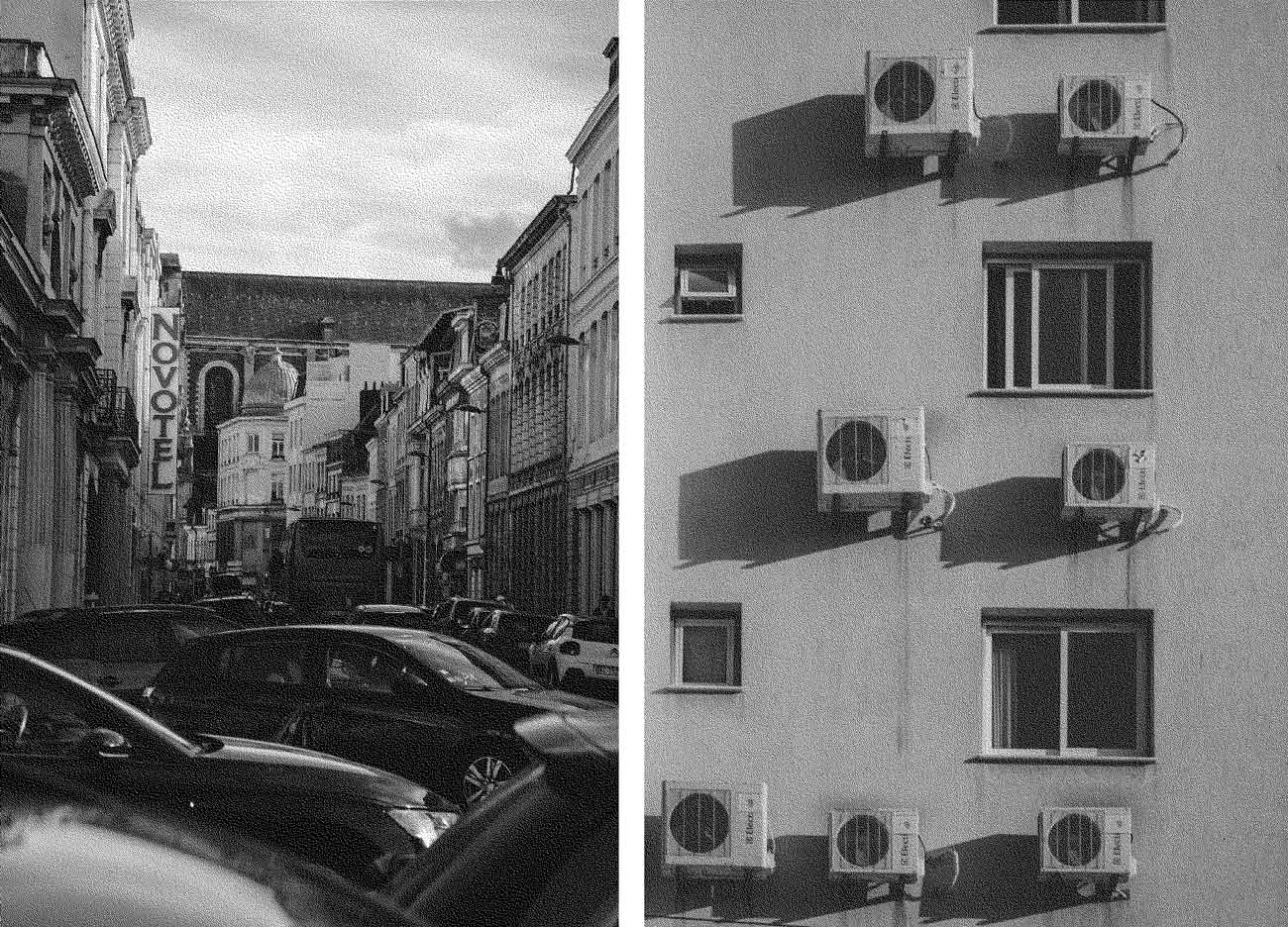
It is becoming increasingly common to hear the argument that waste heat from gasoline and diesel vehicles is far greater than that produced by air conditioners, and therefore that the deployment of air conditioning should not be a concern. But what does the scientific literature actually say?
Internal combustion engine vehicles affect the urban climate in three ways:
1) Waste heat released by their combustion engines (direct impact)
2) The urban space they occupy and the infrastructure they require (indirect impact)
3) The overheating caused by their materials once the vehicle is parked (direct impact)
Regarding this last aspect, a study conducted in Lisbon found that black cars generated a very localized overheating effect within a few tens of centimeters of the vehicle. However, the main contribution obviously comes from engine waste heat.
As surprising as it may seem, there are relatively few scientific studies examining the impact of internal combustion engine vehicles on urban overheating. Yet it is obvious that the heat output of a fuel-powered vehicle is enormous, reaching several tens of kilowatts.
A Mexican study published in 2022 stands out. It modeled different urban street canyons oriented along either a north–south or east–west axis and compared their air temperatures with 0, 10, and 20 vehicles waiting at a traffic light. The results varied considerably depending on street orientation and wind conditions.
In an east–west-oriented street (which remains shaded throughout the day) and under windless conditions, the presence of vehicles increased air temperature by approximately 1°C (from 32 to 33°C). In a north–south-oriented street (which receives more solar radiation) and with no wind, vehicles increased air temperature by around 3.5°C (from 38 to 41.5°C). This represents a much larger increase.
What about air conditioning? To make the comparison meaningful, we assume a level of air conditioning adoption comparable to the prevalence of cars in Europe. To compare the waste heat released by wall-mounted outdoor air conditioning units, we can turn to a Chinese study published in 2025. It relies on thermo-aeraulic simulations that are broadly comparable to those used in the Mexican study.
For this street geometry (H/W = 1), waste heat from façade-mounted air conditioners increases the air temperature at a height of 2 meters by only about 1°C. In an east–west-oriented street, the overheating caused by internal combustion engine vehicles (around 1.5°C) and by air conditioners (1°C) is therefore relatively similar.
However, in a north–south-oriented street, the overheating caused by vehicles is much greater. 3.5°C versus 1°C: in this case, internal combustion engine vehicles have a significantly larger impact. Everything depends on street orientation.
But air conditioning has not had the last word. In very narrow streets where vehicles do not circulate, it becomes the dominant source of waste heat. Under these conditions, façade-mounted units can increase air temperature by as much as 8°C.
Traffic volumes also fluctuate throughout the day, which affects the impact of vehicles at the city scale. A study investigated how electrifying Singapore's vehicle fleet would reduce anthropogenic heat emissions. It used a meso-scale climate model covering the entire island while accounting for daily traffic peaks.
The study found that fully electrifying the vehicle fleet would reduce maximum air temperature by about 0.6°C. But that is not the whole story. Since around 80% of Singapore is air-conditioned, the researchers also compared vehicle electrification with relocating 25% of air conditioner waste heat from façades to rooftops.
The result was striking: relocating just 25% of air conditioner waste heat to rooftops was 2.5 times more effective at reducing street temperatures than replacing every internal combustion engine vehicle. Removing all gasoline and diesel vehicles was less effective than relocating one quarter of outdoor air conditioning units. In Singapore, reducing the impact of air conditioner waste heat is therefore more effective at cooling streets than electrifying the entire vehicle fleet.
This finding is particularly interesting because it comes from a city with very high air conditioning penetration. Of course, one may question whether results obtained under such different climates (Singapore, Mexico, etc.) can be generalized. However, the comparison mainly depends on urban form rather than climate itself, making it meaningful.
So who wins the urban overheating contest? Once again, it depends on the scale considered. The Mexican study clearly shows that internal combustion engine vehicles have a greater impact in certain streets, whereas the Singapore study highlights the significant influence of façade-mounted air conditioners.
If air conditioning continues to expand on a large scale, the claim that gasoline and diesel vehicles contribute more than air conditioners to street overheating needs to be qualified. The answer ultimately depends on both the spatial scale and the urban configuration.
Sources:
- The impact of parked cars
- Waste heat from idling vehicles
- Waste heat released by air conditioners
- The Singapore study
Image: Zhu Yunxiao, Danny Feng (Unsplash)