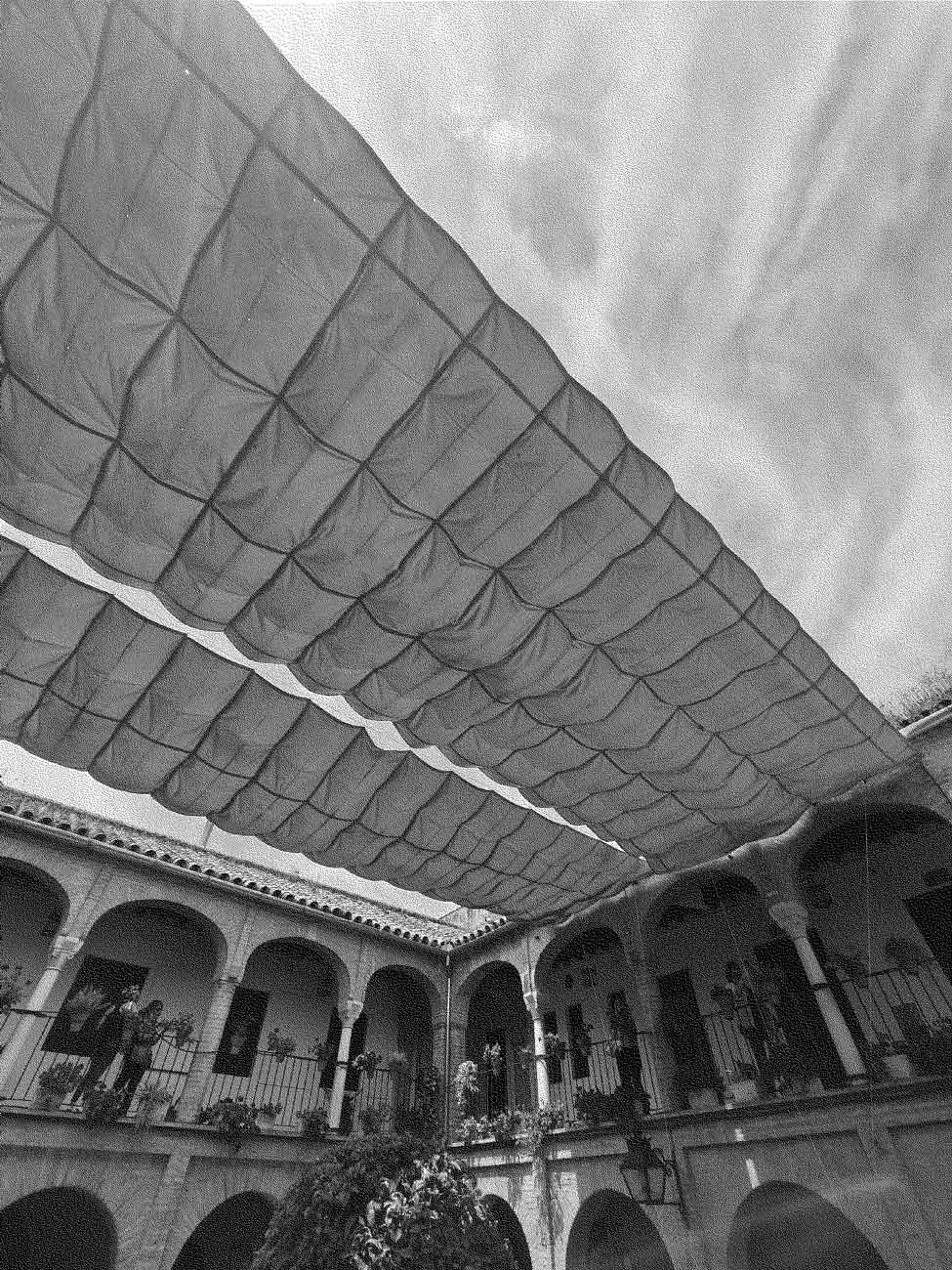
If we were to rank the most underutilized urban cooling strategies in France, I think shade sails would be at the top of the list. Widely used until the early 20th century to shade streets and buildings, they have now completely disappeared from our cities.
Measurements taken in Cordoba show a drop in ground temperature of up to 16°C under shade sails. Yet, this solution remains virtually absent from French cities.
Lightweight, reversible, and aesthetically pleasing, shade sails adapt to all configurations. They offer another key advantage for adapting our cities: they are particularly well-suited to historic centers, where the lack of underground space limits planting possibilities.
While trees are often considered the gold standard for urban cooling, shade sails also offer significant improvements in thermal comfort.
Researchers at the Seville School of Architecture have demonstrated that shade sails improve outdoor thermal comfort for pedestrians by 6 to 9°C UTCI, depending on their orientation. A considerable improvement.
Their effectiveness for outdoor thermal comfort is well established, but shade sails also have an impact on indoor temperatures. The same study showed that they reduced the duration of indoor overheating in buildings by 6% compared to a configuration without shade.
Of course, shade sails present constraints in terms of installation, wind resistance, and fire department access to the facades. However, few urban cooling solutions offer such a level of effectiveness with such minimal intervention.
The only point to consider concerns nighttime cooling: shade sails block long-wavelength radiation. Therefore, the best solution is to retract the shade sails at night and extend them during the day!
Image: Shade sails in an inner courtyard in the city of Cordoba, Spain (C. Gaillard)
Sources:
- Surface temperature measurements in Cordoba (Elena Garcia-Nevado, Benoit Beckers and Helena Coch, 2020)
- Modeling of indoor and outdoor thermal comfort in Seville (Julia Díaz-Borrego, Alicia Alonso and Rocío Escandón, 2025)